SMT Assembly Services: Low Cost or Low Risk?
When evaluating SMT assembly services, the real question is not just cost, but operational risk, quality consistency, and long-term supply resilience. For buyers sourcing custom PCB boards, flexible printed circuits, and devices such as portable ultrasound scanners, smart glucometers, digital blood pressure monitors, wearable ECG monitors, telemedicine carts, and remote patient monitoring systems, the right manufacturing partner can directly affect compliance, performance, and market success.
For most professional buyers, the answer is clear: the lowest quoted price in SMT assembly often creates the highest total risk. If your product must meet reliability targets, regulatory expectations, delivery commitments, and field performance standards, then supplier selection should be based on total value and risk control rather than unit price alone. A low-cost vendor can be the right choice only if they can prove process discipline, traceability, quality systems, engineering support, and stable supply capability.
What buyers are really asking when they compare SMT assembly services
Searchers looking up “SMT Assembly Services: Low Cost or Low Risk?” are usually not asking a theoretical question. They are trying to make a sourcing decision with real commercial consequences. Procurement teams want to know whether a lower assembly quote will lead to hidden costs later. Engineers want confidence that the boards will perform consistently. Quality managers want traceability and process control. Finance approvers want to avoid expensive rework, warranty claims, and supplier disruption.
In practical terms, the core question is this: How do you identify an SMT assembly partner that keeps total cost under control without increasing quality, compliance, or supply chain risk?
That question matters even more in sectors such as smart electronics and healthcare technology, where PCB assembly quality can affect device accuracy, patient safety, product approvals, and brand reputation. A cheaper build is not cheaper if it leads to field failures, delayed launches, failed audits, or repeated engineering changes.
Why “low cost” in SMT assembly can become expensive later
A quote that looks attractive at the purchasing stage may hide costs that appear later across operations, service, and customer support. This is where many buyers underestimate the true economics of SMT assembly services.
Common hidden cost drivers include:
- Yield loss and rework: Poor stencil design, unstable placement accuracy, or weak soldering control can increase defect rates.
- Component sourcing issues: Low-cost suppliers may substitute parts, use unauthorized channels, or struggle with long-term availability.
- Inconsistent documentation: Weak BOM control, unclear revision management, and poor process records increase the risk of build errors.
- Compliance exposure: For medical, industrial, and connected devices, weak traceability can create audit and certification problems.
- Delivery instability: A supplier with low pricing but poor planning can miss deadlines and disrupt downstream production.
- Field reliability failures: Latent solder defects or poor handling of moisture-sensitive components may only appear after products ship.
For custom PCB boards and flexible printed circuits, these risks are magnified because design complexity often requires tighter process windows and better engineering collaboration. In products such as wearable ECG monitors or remote patient monitoring systems, even small assembly deviations can affect signal integrity, battery performance, wireless reliability, or sensor consistency.
What “low risk” SMT assembly actually looks like
Low-risk SMT assembly does not simply mean choosing the most expensive contract manufacturer. It means selecting a partner with proven systems that reduce uncertainty across quality, lead time, engineering, and lifecycle support.
A low-risk SMT assembly provider typically demonstrates the following:
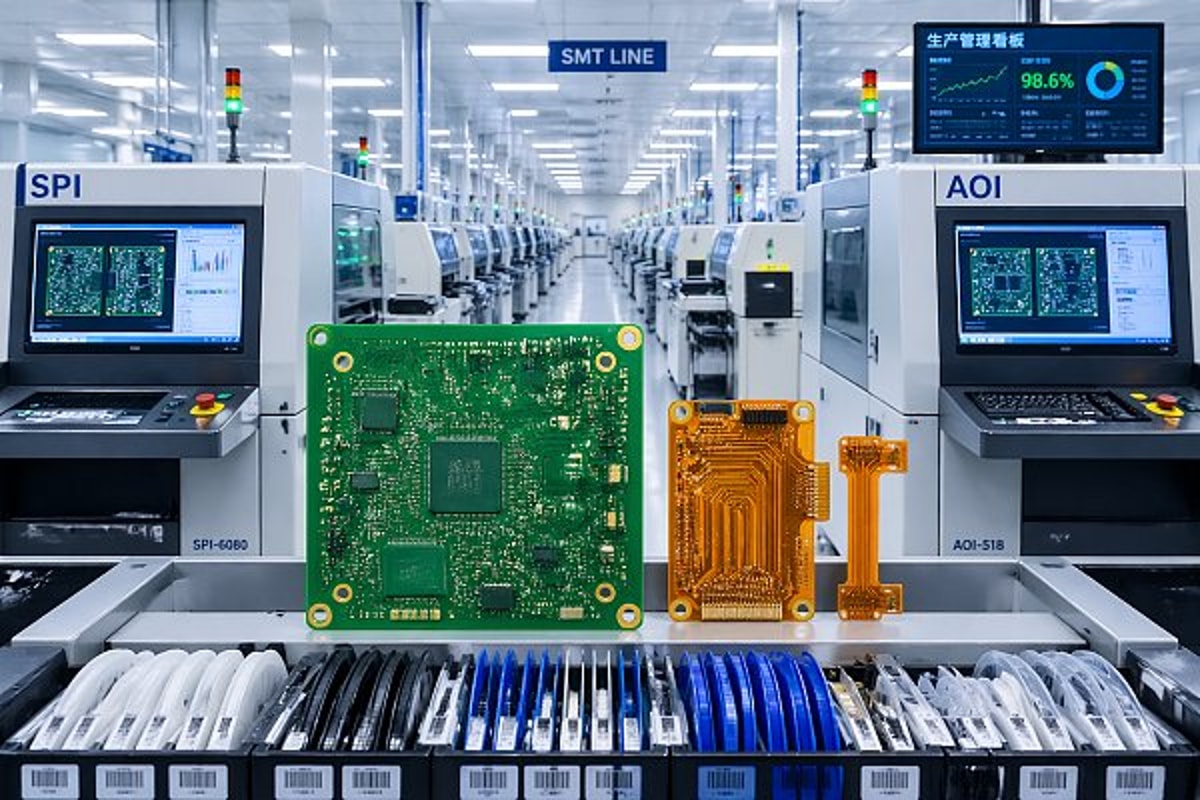
- Strong process control: SPI, AOI, X-ray inspection where required, controlled reflow profiles, and documented work instructions.
- Material traceability: Clear lot tracking for components, solder paste, PCBs, and critical process inputs.
- Engineering readiness: DFM and DFA feedback before production, especially for fine-pitch, BGA, and flex circuit applications.
- Quality certifications: Depending on application, ISO 9001, ISO 13485, IPC standards adherence, and other relevant certifications.
- Controlled sourcing practices: Authorized or vetted component procurement channels and active management of counterfeit risk.
- Change management: Formal ECN handling, revision control, and first article verification.
- Scalability: Ability to support prototyping, pilot builds, and volume production without losing consistency.
For buyers, this means lower operational surprise. For enterprise decision-makers, it means better launch predictability and fewer downstream disruptions. For finance teams, it means less exposure to expensive quality incidents.
How to evaluate an SMT assembly supplier beyond the quotation sheet
If you want to compare SMT assembly services intelligently, focus on a structured supplier evaluation process rather than headline price. A practical assessment framework should cover five dimensions.
1. Process capability
Ask how the supplier manages fine-pitch components, BGAs, QFNs, microcontrollers, and mixed-technology boards. Review their inspection methods, equipment list, profile control, and defect prevention practices. If your design includes flexible printed circuits or compact medical electronics, ask for specific examples of similar builds.
2. Quality system maturity
Look beyond certificates on a slide deck. Ask how nonconformities are handled, how CAPA is implemented, how traceability works at board and batch level, and what data can be shared during audits or investigations.
3. Supply chain resilience
Ask whether they support alternate component planning, last-time-buy strategy, buffer stock options, and approved vendor list management. In volatile markets, supplier resilience often matters more than small price differences.
4. NPI and engineering support
For new product introduction, the best SMT assembly partners identify risks early. They should review Gerbers, BOMs, pick-and-place files, panelization, test strategy, and manufacturability constraints before production starts.
5. Communication and accountability
Many sourcing failures come from slow response, poor escalation, and unclear ownership. A reliable partner should provide defined contacts, clear issue reporting, realistic lead times, and documented action plans.
These factors help buyers compare suppliers based on total execution ability, not just quoted assembly cost.
Special considerations for medical and smart electronic devices
For healthcare technology and advanced smart devices, SMT assembly risk has broader consequences than scrap or delay. It can affect regulatory readiness, clinical confidence, product liability exposure, and long-term brand trust.
Consider device categories such as portable ultrasound scanners, digital blood pressure monitors, smart glucometers, and telemedicine carts. These products often require:
- High signal stability and electrical consistency
- Reliable operation across varying temperature and handling conditions
- Strict revision and component control
- Support for quality documentation and validation records
- Repeatable assembly across pilot and scale-up phases
In these segments, choosing SMT assembly services based on the lowest bid alone can create serious downstream issues. If the manufacturing partner lacks discipline in ESD control, cleanliness, solder joint reliability, or test integration, your product may pass initial inspection but fail in use. For regulated or semi-regulated products, that risk is unacceptable.
When a low-cost SMT assembly provider is still the right choice
Low cost is not automatically bad. In some situations, a competitive supplier can offer excellent value. The key is whether the lower price comes from efficiency rather than shortcuts.
A lower-cost SMT assembly partner may be a smart choice if they can demonstrate:
- Modern, well-utilized production equipment
- Lean operations and good scheduling discipline
- Established local or regional component sourcing advantages
- Low overhead without sacrificing quality controls
- Transparent quoting with no hidden process gaps
This is why due diligence matters. Buyers should not ask only, “Who is cheapest?” but “Why is this supplier cheaper, and what risks are increasing or decreasing because of that?” If the answer is operational efficiency, that can be positive. If the answer is reduced inspection, weak engineering support, or uncontrolled sourcing, the apparent savings may be dangerous.
A practical decision framework: total cost of ownership vs total risk of ownership
A useful way to compare SMT assembly services is to balance total cost of ownership with total risk of ownership.
Total cost of ownership includes:
- Quoted assembly price
- Tooling and setup costs
- Material procurement premiums
- Shipping and logistics expenses
- Inspection, testing, and qualification costs
- Rework and warranty exposure
Total risk of ownership includes:
- Quality drift over time
- Single-source component vulnerability
- Poor documentation or traceability
- Inflexibility during engineering changes
- Production delays during demand fluctuations
- Audit, compliance, or customer complaint exposure
For procurement directors and project managers, this framework is especially useful because it translates a technical sourcing decision into business terms. It helps align engineering, quality, operations, and finance around the same decision criteria.
Questions to ask before selecting an SMT assembly partner
To reduce sourcing mistakes, buyers should ask direct, evidence-based questions during supplier evaluation:
- What similar products have you assembled in our industry?
- How do you handle DFM feedback before launch?
- What inspection and test methods are standard for our board type?
- How do you ensure traceability for components and finished assemblies?
- What is your process for BOM changes, shortages, and approved substitutions?
- What certifications and audit history can you share?
- How do you manage pilot builds versus volume ramp-up?
- What are your typical causes of defects, and how are corrective actions tracked?
- Can you support flex circuits, miniaturized assemblies, or mixed-technology boards if needed?
- What service levels and communication structure will we receive after onboarding?
The quality of the answers often tells you more than the quote itself. Reliable suppliers answer with specifics, data, and process evidence. Risky suppliers tend to stay vague.
Conclusion: the best SMT assembly service is the one that protects margin, quality, and continuity
For serious B2B buyers, the choice between low cost and low risk is rarely binary. The best SMT assembly service is the provider that delivers competitive pricing and controlled execution. But when those two goals conflict, low risk usually creates the stronger long-term business outcome.
If your product depends on custom PCB boards, flexible printed circuits, or high-reliability electronics for medical and smart device applications, prioritize supplier capability, quality systems, sourcing discipline, and traceability. A slightly higher upfront quote can protect your launch timeline, reduce compliance exposure, and preserve customer trust.
In short, the smartest sourcing decision is not about finding the cheapest SMT assembly partner. It is about finding the partner that keeps your total cost low by keeping your operational risk lower.
Get weekly intelligence in your inbox.
No noise. No sponsored content. Pure intelligence.
 May 02, 2026Commercial EV Charging Installation Costs Beyond the HardwareCommercial EV Charging Installation Costs Beyond the Hardware
 May 02, 2026Portable EV Charging Solutions: Where They Actually FitPortable EV Charging Solutions: Where They Actually Fit
 May 02, 2026Why Automotive Aluminum Extrusions Fail at Joining PointsWhy Automotive Aluminum Extrusions Fail at Joining Points
 May 02, 2026Sheet Metal Bending Services in the USA: What Drives Lead TimeSheet Metal Bending Services in the USA: What Drives Lead Time
 May 02, 2026Cost-Effective Factory Automation Often Starts Smaller Than ExpectedCost-Effective Factory Automation Often Starts Smaller Than Expected
 May 02, 2026Choosing a Solar Panels Wholesale Distributor Without Price TrapsChoosing a Solar Panels Wholesale Distributor Without Price Traps
 May 02, 2026High Efficiency PV Modules: When the Premium Makes SenseHigh Efficiency PV Modules: When the Premium Makes Sense
 May 02, 2026Why Data Centers Are Rethinking ESS Backup StrategyWhy Data Centers Are Rethinking ESS Backup Strategy
 May 02, 2026Do Agricultural PV Modules Need Different Frame Designs?Do Agricultural PV Modules Need Different Frame Designs?
 May 02, 2026How to Vet an OEM Machined Parts Supplier in GermanyHow to Vet an OEM Machined Parts Supplier in Germany
 May 02, 2026Custom Metal Fabrication for Aerospace: Cost vs CertificationCustom Metal Fabrication for Aerospace: Cost vs Certification
 May 02, 2026What Slows Rapid Prototyping for Automotive Parts MostWhat Slows Rapid Prototyping for Automotive Parts Most
 May 02, 2026Rapid Prototyping Choices That Cut Delays in Consumer ElectronicsRapid Prototyping Choices That Cut Delays in Consumer Electronics
 May 02, 2026Why Aerospace Parts Need More Than Tight Lathe TurningWhy Aerospace Parts Need More Than Tight Lathe Turning
 May 02, 2026What Fireproof Technology Really Changes in Lithium BatteriesWhat Fireproof Technology Really Changes in Lithium Batteries
 May 02, 2026Are Grid-Tied Hybrid Inverters Enough for Unstable Supply?Are Grid-Tied Hybrid Inverters Enough for Unstable Supply?
 May 02, 2026What a Solar Panels Wholesale Price List Does Not ShowWhat a Solar Panels Wholesale Price List Does Not Show
 May 02, 2026How Long Life Cycle Batteries Lower Replacement CostsHow Long Life Cycle Batteries Lower Replacement Costs
 May 02, 2026Lathe Turning Tolerances That Matter in Industrial MachineryLathe Turning Tolerances That Matter in Industrial Machinery
 May 02, 2026ESS for Commercial Buildings: Sizing Mistakes to AvoidESS for Commercial Buildings: Sizing Mistakes to Avoid
 May 02, 2026Warehouse Robotics Bottlenecks That Slow Automation ROIWarehouse Robotics Bottlenecks That Slow Automation ROI
 May 02, 2026Where Smart Manufacturing Pays Off First in Auto PlantsWhere Smart Manufacturing Pays Off First in Auto Plants
 May 02, 2026Marine Aluminum Extrusions: What Corrosion Ratings MissMarine Aluminum Extrusions: What Corrosion Ratings Miss
 May 02, 2026Plastic Injection Molding Machine Specs That Affect OutputPlastic Injection Molding Machine Specs That Affect Output
 May 02, 2026What Limits 5 Axis Milling Accuracy for Medical Devices?What Limits 5 Axis Milling Accuracy for Medical Devices?
 May 02, 2026How to Compare a Die Casting Parts Manufacturer in ChinaHow to Compare a Die Casting Parts Manufacturer in China
 May 02, 2026Why Oil and Gas Projects Still Rely on Steel ForgingWhy Oil and Gas Projects Still Rely on Steel Forging