Industrial IoT Gateways That Handle Legacy Machines Better
For technical evaluators modernizing brownfield operations, industrial iot gateways are often the critical link between legacy machines and real-time data systems. The right gateway can simplify protocol conversion, reduce integration risk, and extend equipment life without costly replacement. This article explores what makes certain gateways better suited for aging industrial environments and how to assess them with confidence.
Why are industrial iot gateways so important for legacy machines?
In mixed-age factories, utilities, warehouses, and process lines, many critical assets still operate reliably after 10, 15, or even 25 years. The problem is not always mechanical performance; it is data accessibility. Older PLCs, CNCs, drives, meters, and controllers often speak protocols that modern cloud platforms, MES systems, analytics tools, or Supply Chain SaaS layers cannot read directly. Industrial iot gateways bridge that gap by translating machine data into usable, structured information.
For technical evaluators, the main value of industrial iot gateways is risk reduction. Replacing a production-critical machine may require shutdown windows of 24 to 72 hours, electrical revalidation, control logic updates, and operator retraining. A gateway-based retrofit can often be evaluated in weeks rather than quarters, especially when the target is visibility, condition monitoring, OEE tracking, energy reporting, or remote diagnostics rather than full machine replacement.
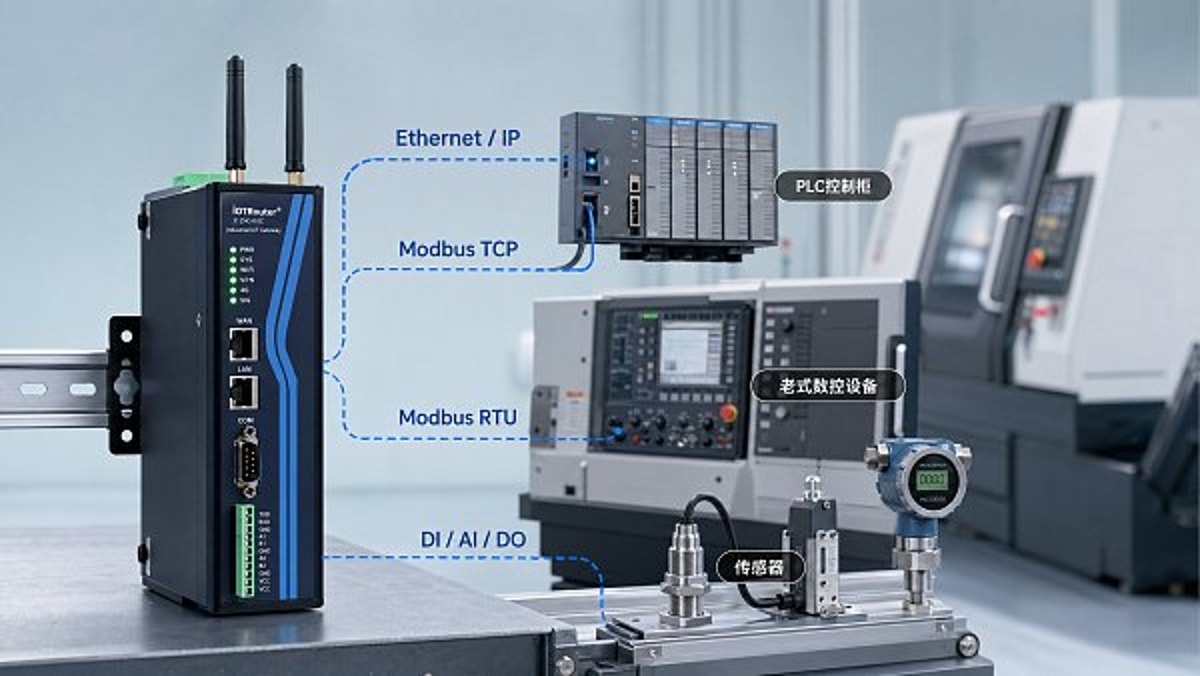
Another reason these devices matter is architecture flexibility. A well-chosen gateway can collect serial data, Ethernet data, digital I/O signals, and sensor input in one place, then forward the result upstream through MQTT, OPC UA, HTTPS, or REST APIs. That means one gateway may support 20 to 200 data points on a single cell, depending on polling rate, edge logic, and protocol complexity.
What problem does the gateway solve first?
The first problem is usually not “AI readiness” or “full digital transformation.” It is basic interoperability. Legacy assets may use Modbus RTU, Modbus TCP, PROFIBUS, CAN, proprietary serial variants, or simple dry-contact outputs. Modern business systems prefer normalized, timestamped, secure data streams. Industrial iot gateways sit between the machine and the enterprise stack so technical teams do not need to rewrite every upstream application around every old asset.
Typical brownfield benefits include:
- Extending useful equipment life by 3 to 7 years when the machine is still operationally sound.
- Reducing integration complexity by consolidating 2 to 6 protocols into one upstream interface.
- Supporting phased modernization so plants can digitize one line, one utility room, or one site at a time.
- Improving data collection frequency from manual shift logs to intervals such as every 1 second, 5 seconds, or 1 minute.
For organizations that manage globally distributed operations, this phased approach also helps standardize data pipelines across different geographies and machine vintages. That makes industrial iot gateways especially relevant in advanced manufacturing, green energy infrastructure, smart electronics assembly, healthcare production environments, and logistics automation facilities.
Which features make industrial iot gateways better for aging industrial environments?
Not every gateway that performs well in a new facility performs well beside older machines. Brownfield environments demand tolerance for inconsistent wiring, protocol quirks, electrical noise, and incomplete documentation. Technical evaluators should focus less on feature volume and more on feature relevance. In practice, a gateway that handles unstable field conditions cleanly is often more valuable than one with a longer but less usable software checklist.
The most important capability is protocol flexibility at the edge. Legacy lines often contain a mix of serial RS-232, RS-485, Ethernet, and discrete signal points. If one gateway only supports modern Ethernet-native devices, it may increase project scope instead of reducing it. Equally important is local buffering. In many plants, network quality is uneven, and historical continuity matters. Store-and-forward capability can preserve data for 12 hours to several days during connectivity interruptions.
Environmental and maintenance factors also matter. Fanless design, wide operating temperature tolerance, DIN-rail or panel mounting, and remote management functions all influence long-term reliability. Many brownfield deployments occur in enclosures with temperatures from 0°C to 50°C, and some harsher sites may require tolerance beyond that range. A gateway that needs frequent physical access may not be ideal for remote substations, rooftop energy assets, or tightly controlled production rooms.
What should evaluators prioritize first?
Start with the machine-side interface, not the cloud-side dashboard. If the gateway cannot reliably read the source asset, every downstream promise becomes irrelevant. Confirm protocol support, polling behavior, data typing, exception handling, and whether the device can work with undocumented or partially documented registers. Many successful brownfield projects begin with 5 to 20 high-value tags rather than trying to capture every variable on day one.
The table below summarizes the most practical evaluation criteria for industrial iot gateways in legacy machine environments.
A useful way to read this table is to ask where failure is most expensive. If protocol mismatch blocks data capture, the project stops immediately. If edge processing is weak, the project may still launch but create noisy, low-trust data. If resilience and security are under-specified, problems may appear 3 to 12 months later when scaling to additional lines or remote sites.
Are rugged hardware specs enough?
No. Rugged hardware is necessary, but it is only one layer. A durable enclosure does not guarantee clean data mapping, manageable firmware updates, or maintainable integration workflows. Some teams overemphasize ingress protection and underemphasize configuration usability. In practice, engineering hours spent troubleshooting tag mapping, timestamp drift, or unstable polling can exceed the cost difference between two hardware options.
For technical evaluators, the strongest candidates are industrial iot gateways that combine physical robustness with software transparency. You should be able to understand how the device handles retries, queue depth, local storage thresholds, and data export behavior before rollout, not after commissioning.
How do you compare industrial iot gateways for different legacy machine types?
Comparison should begin with machine category, because the data challenge is not the same across all assets. A packaging line PLC, a utility meter bank, an older CNC machine, and a medical equipment support system may all require different gateway behaviors. Some need high-frequency polling at sub-second or 1-second intervals, while others only need 1-minute or 15-minute summaries for energy and maintenance reporting.
It is also important to separate direct control from monitoring use cases. Most brownfield gateway projects focus on visibility, event tracking, condition monitoring, or system integration. If the requirement includes closed-loop control, the validation burden rises sharply. In those cases, technical evaluators should review system architecture, fail-safe behavior, and operational responsibility boundaries much more carefully.
The comparison matrix below shows how evaluation priorities shift by legacy asset type.
This comparison matters because a gateway that performs well in utility telemetry may be too limited for machine-level production analytics, and a gateway optimized for dense factory polling may be unnecessarily complex for remote energy assets. The best industrial iot gateways are not universally “best”; they are best aligned to asset behavior, network conditions, and business outcome.
What are good shortlisting questions?
- Can the gateway connect to our oldest target machine without adding extra converters?
- How many tags can it poll reliably at our required interval, such as 1 second, 5 seconds, or 60 seconds?
- What happens if the site network fails for 4 hours, 12 hours, or 48 hours?
- Can local rules reduce noise before data is sent to MES, ERP, or cloud applications?
- How difficult is remote firmware management across 10, 50, or 100 deployed units?
These questions help technical evaluators avoid feature-led purchasing. The objective is not to buy the gateway with the longest brochure. It is to identify the one that will perform consistently in your actual machine, plant, and integration context.
What implementation risks and mistakes should technical evaluators watch for?
One of the most common mistakes is assuming that protocol compatibility equals project readiness. A datasheet may list a protocol family, but practical success depends on register access, machine firmware behavior, controller revision differences, and data semantics. Two machines from the same vendor can expose different data quality depending on age, configuration, or retrofit history. That is why pilot testing should validate real tag reads rather than just interface claims.
A second mistake is collecting too much data too early. Brownfield modernization often succeeds when teams start with 10 to 30 operationally meaningful signals: run state, fault state, cycle count, temperature band, power consumption, or downtime code. Trying to map 300 variables before proving value can delay launch, increase debugging, and create governance problems for historians, dashboards, and enterprise applications.
Security is another underestimated area. Legacy machines may not support secure authentication, segmented networking, or modern encryption practices. Industrial iot gateways should not be treated as a simple cable replacement. They become a strategic edge node, and their deployment should align with plant network segmentation, access control, update policy, and incident response planning.
Which warning signs deserve extra attention?
- No clear testing plan for live machine communication before broader rollout.
- Uncertain ownership between OT, IT, maintenance, and operations teams.
- No documented strategy for firmware updates, credential rotation, or backup configuration.
- Assumption that one gateway profile will fit every site, line, and machine generation.
- No threshold defined for acceptable data loss, latency, or recovery time.
A practical evaluation sequence
A disciplined evaluation sequence usually works better than a broad procurement push. Start with one representative machine cell, one gateway candidate set, and one business objective such as uptime visibility or energy tracking. Run a proof phase for 2 to 6 weeks, then review data stability, operator acceptance, support workload, and integration quality. Only after that should the team define a repeatable rollout template.
This measured approach is especially useful for multinational procurement and supply chain teams. It creates reusable standards across sites while respecting local machine variation. For sectors such as healthcare technology and smart electronics, where process continuity and documentation discipline are essential, structured gateway validation can prevent avoidable project drift.
How should you evaluate cost, deployment timeline, and long-term scalability?
Cost evaluation should go beyond unit price. A lower-cost gateway may require additional converters, more engineering hours, limited remote support, or more frequent site visits. In brownfield projects, the true cost often includes hardware, protocol setup, software licensing, commissioning labor, cybersecurity alignment, and ongoing support. For a modest pilot, the engineering effort can rival the hardware cost if integration assumptions are weak.
Deployment timeline also varies by use case. A simple meter aggregation project may move from test to installation in 2 to 4 weeks. A mixed-machine production environment with custom mapping, multiple stakeholders, and historian integration may require 6 to 12 weeks for a careful first phase. Technical evaluators should ask whether the proposed architecture supports scaling from 5 devices to 50 devices without redesigning the management model.
Scalability is not only about device count. It also includes configuration consistency, naming conventions, data model reuse, and support workflows. If every new gateway requires fully manual setup, a rollout that looks manageable at one site may become expensive across 8 plants or 3 regions. Industrial iot gateways that support standardized templates and remote administration often create stronger long-term economics.
What should be included in a realistic business case?
A realistic business case should compare machine replacement against selective digital extension. In many facilities, the relevant question is not whether a legacy asset is ideal, but whether it can deliver another 3 to 5 productive years if it becomes more visible, measurable, and supportable. If a gateway enables earlier fault detection, maintenance planning, reduced manual logging, and better throughput analysis, the value may be operational rather than purely capital-based.
The FAQ-style summary below helps evaluators frame implementation expectations.
This table highlights an important point: industrial iot gateways are often a strong modernization tool, but they are not a universal substitute for machine renewal. The right use case is one where asset function remains valuable, but data accessibility, monitoring depth, or integration capability is insufficient for current operational goals.
What should you confirm before moving to supplier discussions or procurement?
Before engaging suppliers in detail, technical evaluators should prepare a practical requirement package. This should include machine inventory, controller types, available communication ports, target tags, desired polling intervals, network constraints, environmental conditions, and the destination system for data consumption. Even a 1-page requirement summary can dramatically improve solution quality because it reduces guesswork during the first technical conversation.
It is also useful to define success criteria in operational terms. For example, the project may be considered successful if it captures uptime, faults, and cycle counts from 12 legacy machines at 95% or better data continuity over a 30-day period. Clear criteria help procurement teams compare options on performance relevance instead of sales language alone.
For organizations evaluating industrial iot gateways across multiple sectors, from manufacturing to green energy to supply chain facilities, supplier conversations should also cover long-term support structure. Ask about onboarding workflow, remote troubleshooting approach, expected lead times, documentation quality, and how custom integration requests are handled when a site includes unusual machine combinations.
Why choose us for guidance on gateway evaluation?
TradeNexus Pro supports enterprise buyers, technical evaluators, and cross-border industrial decision-makers who need clarity before committing time and budget. Our industry focus across advanced manufacturing, green energy, smart electronics, healthcare technology, and Supply Chain SaaS helps connect gateway selection to the larger operational and procurement context, not just the device itself.
If you are reviewing industrial iot gateways for legacy equipment, we can help you structure the evaluation around practical factors such as protocol fit, data architecture, rollout sequence, deployment timeline, and supplier alignment. This is especially useful when the project spans multiple sites, mixed machine generations, or integration targets such as MES, ERP, cloud monitoring, or digital maintenance platforms.
Contact us to discuss:
- Parameter confirmation for legacy machine communication and expected data volumes
- Product selection criteria for different brownfield asset types
- Estimated deployment cycle for pilot, phased rollout, or multi-site expansion
- Custom solution direction for mixed protocols, edge processing, and upstream integration
- Certification and compliance considerations relevant to your operating environment
- Sample support, quotation communication, and supplier comparison priorities
If you need a more precise shortlist, a requirements review, or a structured comparison for industrial iot gateways, contact TradeNexus Pro with your machine types, protocol environment, and target systems. A well-prepared first discussion can save weeks of trial-and-error and lead to a modernization path that is practical, scalable, and easier to defend internally.
Get weekly intelligence in your inbox.
No noise. No sponsored content. Pure intelligence.
 May 02, 2026Commercial EV Charging Installation Costs Beyond the HardwareCommercial EV Charging Installation Costs Beyond the Hardware
 May 02, 2026Portable EV Charging Solutions: Where They Actually FitPortable EV Charging Solutions: Where They Actually Fit
 May 02, 2026Why Automotive Aluminum Extrusions Fail at Joining PointsWhy Automotive Aluminum Extrusions Fail at Joining Points
 May 02, 2026Sheet Metal Bending Services in the USA: What Drives Lead TimeSheet Metal Bending Services in the USA: What Drives Lead Time
 May 02, 2026Cost-Effective Factory Automation Often Starts Smaller Than ExpectedCost-Effective Factory Automation Often Starts Smaller Than Expected
 May 02, 2026Choosing a Solar Panels Wholesale Distributor Without Price TrapsChoosing a Solar Panels Wholesale Distributor Without Price Traps
 May 02, 2026High Efficiency PV Modules: When the Premium Makes SenseHigh Efficiency PV Modules: When the Premium Makes Sense
 May 02, 2026Why Data Centers Are Rethinking ESS Backup StrategyWhy Data Centers Are Rethinking ESS Backup Strategy
 May 02, 2026Do Agricultural PV Modules Need Different Frame Designs?Do Agricultural PV Modules Need Different Frame Designs?
 May 02, 2026How to Vet an OEM Machined Parts Supplier in GermanyHow to Vet an OEM Machined Parts Supplier in Germany
 May 02, 2026Custom Metal Fabrication for Aerospace: Cost vs CertificationCustom Metal Fabrication for Aerospace: Cost vs Certification
 May 02, 2026What Slows Rapid Prototyping for Automotive Parts MostWhat Slows Rapid Prototyping for Automotive Parts Most
 May 02, 2026Rapid Prototyping Choices That Cut Delays in Consumer ElectronicsRapid Prototyping Choices That Cut Delays in Consumer Electronics
 May 02, 2026Why Aerospace Parts Need More Than Tight Lathe TurningWhy Aerospace Parts Need More Than Tight Lathe Turning
 May 02, 2026What Fireproof Technology Really Changes in Lithium BatteriesWhat Fireproof Technology Really Changes in Lithium Batteries
 May 02, 2026Are Grid-Tied Hybrid Inverters Enough for Unstable Supply?Are Grid-Tied Hybrid Inverters Enough for Unstable Supply?
 May 02, 2026What a Solar Panels Wholesale Price List Does Not ShowWhat a Solar Panels Wholesale Price List Does Not Show
 May 02, 2026How Long Life Cycle Batteries Lower Replacement CostsHow Long Life Cycle Batteries Lower Replacement Costs
 May 02, 2026Lathe Turning Tolerances That Matter in Industrial MachineryLathe Turning Tolerances That Matter in Industrial Machinery
 May 02, 2026ESS for Commercial Buildings: Sizing Mistakes to AvoidESS for Commercial Buildings: Sizing Mistakes to Avoid
 May 02, 2026Warehouse Robotics Bottlenecks That Slow Automation ROIWarehouse Robotics Bottlenecks That Slow Automation ROI
 May 02, 2026Where Smart Manufacturing Pays Off First in Auto PlantsWhere Smart Manufacturing Pays Off First in Auto Plants
 May 02, 2026Marine Aluminum Extrusions: What Corrosion Ratings MissMarine Aluminum Extrusions: What Corrosion Ratings Miss
 May 02, 2026Plastic Injection Molding Machine Specs That Affect OutputPlastic Injection Molding Machine Specs That Affect Output
 May 02, 2026What Limits 5 Axis Milling Accuracy for Medical Devices?What Limits 5 Axis Milling Accuracy for Medical Devices?
 May 02, 2026How to Compare a Die Casting Parts Manufacturer in ChinaHow to Compare a Die Casting Parts Manufacturer in China
 May 02, 2026Why Oil and Gas Projects Still Rely on Steel ForgingWhy Oil and Gas Projects Still Rely on Steel Forging